Showing posts with label early-years. Show all posts

Tuesday, 14 July 2015

Prof. Dwijendra Tripathy remembers...

Although I was on the IIM-A faculty when Labdhi joined the Institute's Post Graduate Programme (PGP) in July 1965, I had very little interaction with him as he had not taken my course. However, some of my colleagues, whose courses he had taken and who had known him better, often talked very favourably about his academic capabilities and sophisticated behaviour. I had a chance to get to know him better when he returned to the Institute as a member of the faculty after a stint as an executive with Hindustan Lever. He took very little time to adjust to his new environment and impressed his faculty colleagues as well as his students with his teaching ability.

I had a personal taste of Labdhi's human qualities when I was his guest for a few days at New York in December 1973. He was doing his Ph.D. at Colmbia University with the Institute's sponsorship. I was on a brief visit to the United States as the Institute's Dean --- the position was newly created to assist the Director in discharge of his duties --- to study the process of academic planning in the American universities. Despite the heavy load of studies, Labdhi was very generous with his time and attention during my stay with him. I still have a vivid memory of his gracious hospitality. 

After he returned home with a Columbia Ph.D., he soon established himself as one of the most admired teachers at the Institute. Though somewhat withdrawn from the humdrum of campus life, he won the love and respect of his colleagues and students alike. There was a widespread belief in the Institute community that he would be the next Director. Alas, cruel death denied the Institute this good luck. His smiling face and gracious manners will always be missed by those who came in his contact. 

A day or two after the tragic air crash, I recall that Mudra, Ahmedabad (where a number of IIM-A graduates were working) had put up an advertisement in the Times of India as a tribute to Labdhi. If my memory serves right, it consisted of a lamp or candle, a symbol of light, that had been suddenly extinguished. It was a very touching tribute that summed up what everyone was feeling. 

*Prof. Dwijendra Tripathi was Prof. of Business History at IIM, Ahmedabad and a colleague of LRB.

Sunday, 12 April 2015

Sampat Singhvi remembers his childhood friend....

I write this with a heavy heart since Labdhi and I were childhood friends and classmates throughout our school years from elementary through high school (Higher Secondary as it was called during those years). He was one of a few school friends that I kept in touch with on a regular basis after I graduated. While he was an Arts student and I majored in Science, this only separated us from being in the same class from grades 9 to 11. Otherwise, we used to sit in the same class from primary school to 8th grade.

We had a lot in common as we both came from a middle class family, from a small town (Sojat City with a population of 25,000 during our growing years), where education was given some importance but family guidance, support, and encouragement for studying hard and career building was lacking. So we had to build our own educational and professional careers.

During primary and middle school, either he or I would be the top student, but the recognition and rewards for being on top, from family, society, or school were simply missing. Consequently, we did not make much of being the top student in those schooling years. After High School graduation, Labdhi went to Jodhpur to do his BA, while I went to Pilani for my Pharmacy degree. During those years we probably did not see each other very much, although if were both back in Sojat in the summers, we would meet and spend time together.

My social meetings with him re-started and became more frequent after my graduation from Pilani in 1967, while I was living with my family in Mumbai for one year, before leaving for the US for graduate studies. During this year, Labdhi was working at Hindustan Lever after his graduation from IIM-A, and lived with Mr. HR Bhandari (another Sojat native) in Worli. So I would go see him and HR occasionally. Sometimes he would come to my house in Vile Parle and we would spend some time together, or meet for lunch near Churchgate close to his work place. I would consult with him about my career goals and what I should do in future. His clarity of thought and encouragement for higher education was instrumental in me applying for admission in US colleges for my graduate studies.

For a few years while I was studying in the US, we did not have close contact until 1971 when I returned to India for a summer break and to getting married. LRB was able to come to my wedding in Pune in the of summer of 1971; he was the only schoolmate from Sojat that attended my wedding, partly because I had lost touch with others during the five years that I was in Pilani and also because my wedding date was fixed in a hurry. I missed Labdhi’s wedding as I was still studying in the US towards my Ph.D.

The next time we saw each other was when I was working in New Jersey and he came to NY for his Ph.D. program at Columbia University. We met frequently - mostly in NY, but also occasionally in NJ. Later he would be joined by his lovely wife, Santosh. Following his Ph.D. and return to India to take up a faculty position at IIM-A, we were only able to meet whenever I would visit India during my social visits. We remained in touch one way or the other. Then one day I heard about the tragic event that took his life and it was just unbelievably sad; I got all the details about how this happened from my family and our common friends. What a tragic loss to his family, close friends, society in general, and importantly to the whole country. As we all know, he was a great asset to the academic and industrial arena in the marketing field. His intellect, sharpness, and wit were just superb. He was simply an extraordinary man with a great potential to make immeasurable contribution to society and the country. What was amazing about him is that he chose to make his career in academia although he could have done much better in industry from a financial perspective. It was a choice he made to go into academia and he was proud of that decision without any hesitation or after thought.

For me personally, it was just as big a shock as I lost a very close friend that I had grown up with, a person who was so similar to me in many ways, and somebody who I could relate with in many different ways. My family liked to see him all the time and likewise, I also enjoyed seeing ‘Baiji’ and Labdhi’s brothers whenever I saw them. His older brother, Dr. B.S. Bhandari (Lalasa, as we called him, who is a great physicist), also stayed in US for a few years. My wife and I would visit him and his wife whenever we had an opportunity. For a while they were the source of getting information about Labdhi and his family.


LRB came from a small town, and a family with limited means, but made a name for himself by his superb accomplishments in business arena and his legacy will last forever.

*Dr. Sampat Singhvi was LRB's childhood friend. He recently retired after a long career in the pharmaceutical industry in the United States and now lives in Princeton, NJ. 

Friday, 5 December 2014

LRB remembers his PGP1 struggles ...

In 1966 LRB was 18 years old and a 2nd year PGP student at IIM-Ahmedabad. An assignment for a  course on inter-personal relations required him to write a detailed biographical sketch and carry out a self-analysis. Remarkably, this hand-written, 20+ page document has survived almost 50 years and gives us a remarkable glimpse into how LRB's early years. Below, we present an edited extract from the document that describes his experience as a PGP-1 student at IIM-A. LRB describes his struggles with the IIM-A environment and curriculum, the resulting crisis of confidence, and the transformation that he went through. The extract has been edited for clarity and grammar. 

I arrived at the Indian Institute of Management Ahmedabad with my friend from Jodhpur University on the 6th of July 1965. I still had 23 more days to go before I was 17 years old. I came here with lots of hopes, fears and uncertainties in my mind about the future, but also a lot of confidence. I had done well in my college final examinations, despite not having studied much. I felt confident about facing the IIM-A environment.

As soon as I entered, however, everything began to change. All the people around me were older, more sophisticated, and smartly dressed. I was completely lost. I had had a similar experience at the time of entering college - but this was more severe. At college, at least communication was no problem. I could talk to people in Hindi, but here everybody was talking in English and I could not even speak English correctly and fluently.1 I had only studied 'General English' as a subject during school and two years of college. I had never written my other papers in English and occasions to speak in English had been very rare. My friend, who was 23 years old, came from an English-medium school and he could manage in this environment. But he was to stay in a different flat2 than me, and I was completely lost. 

The orientation programme created more fears in my mind than it cleared. The first week of classes frustrated me even more. I could not even finish the first reading of cases and assigned readings during that time. I did not know what was happening. People were participating in class, but I couldn't open my mouth even once during the first month. Some of the courses were heavy in mathematics. Mathematics has never been my favorite subject, and here it brought me to the brink of collapse.

Many people were thinking of leaving the course and the dropouts had already started. I gave a thought to this idea and immediately rejected it. I had come here on my own, absolutely on my own - in fact against my family's and relation's wishes. I couldn't go back and say that IIM-A is too difficult for me to go through. I wrote back home to say that I wouldn't come back unless I was thrown out. By the end of two months, the rate of dropouts had increased. Our first set of grades had come back,  bringing another wave of shocks. My father came down to Ahmedabad and so did my friend's father. I told my father not to bother about me. I wouldn't leave IIM-A. I would like to fight with all this.

About 20 days later, after another shock wave of grades had hit us, my friend left the institute. He was very frustrated. His arrival at his home in Jodhpur created trouble in my family and my aunty3 advised me by telegram to come home if I was not comfortable. But I had decided to face all this. By this time my flat mates and I had come closer and could share this frustration. But all of them had adjusted themselves better than what I had done. 

I started working very hard by cutting into my sleeping time. Reading and grasping new subjects  written in English (a foreign language to me) was a tough job for me. I couldn't follow some of the professor's accents. But my tutor realized my plight and supported me. He used to call me and help me in everything, encourage me and give me special opportunities in class to talk. This coupled with my hard work (I have never worked so hard in my life) gave me a boost of confidence. I was improving and trying to fall in the 'satisfactory' category. I did my best and I could see that I was improving steeply. The class also had an image of me as someone who was trying to improve his position and they would give me a privileged response in class to encourage me. The first term passed in this struggle for existence. My self image, confidence and identity had been shattered badly, but I had started repairing them. Meanwhile, I could only hope to keep my head above water.

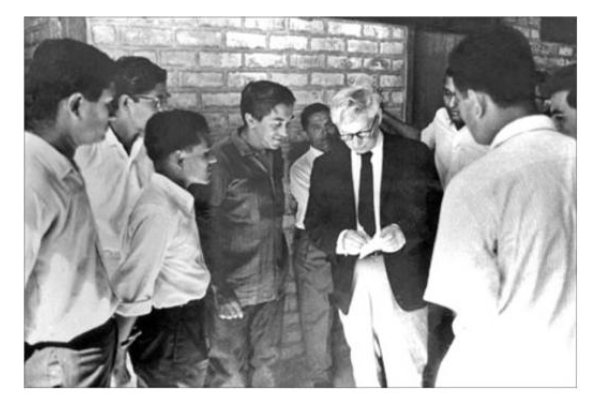
IIM-A students (LRB is 2nd from left) crowding around Louis Kahn, the celebrated architect, and Prof. Ravi Mathai.

I returned from the term holidays to continue the struggle. One classmate of mine (who was at the time one of the topmost students) congratulated me for securing an A grade in Marketing - the only A of the class. I thought they were joking and felt really bad that people were pulling my leg and laughing at my plight. Some more people started talking about it at the tea table and later on I came to know that I had really got an 'A'. My other grades also were quite good. My confidence was again rebuilt overnight. I started on second term subjects with a lot of enthusiasm, working late in the nights in solving cases. I used to participate in class everyday. My image was improved amongst my class mates.

About a month after the second term had started, however, I fell sick4. I had to be out of touch with studies for more than 35 days. I again became skeptical about my existence at IIM-A. The thought of whether or not I would be able to recover the study time I was losing kept eating my mind all the time. But all the instructors were impressed by me and were very sympathetic after I came back. They gave me all the help required and I was soon able to cope with the class. Now I was amongst above average students. My performance in the last term was very encouraging. I secured second rank in the institute missing first by one grade point.5

But another thing happened during the final term of the first year. Summer placement activities had started and everybody was hunting for jobs. It so happened that I was called for interviews for almost every job I applied, but I was not selected. Major influencing factor for the decisions against me was my exceptionally young age. Everybody said: you are too young. I was very frustrated by this and started cursing myself for starting my studies early, coming to IIM-A etc. I was confident about my abilities and I also cursed employers for not recognizing my abilities and colouring their attitude with mere chronological age. Eventually, I accepted a summer project in south India for which selection was made by resume. 

I went to the south in the summer all alone for this project. I was traveling such a long distance alone for the first time. My aunty sent me with a heavy heart. I joined the company and started work on a project about which we had not learned anything during the first year. But, I decided to do a good job for the company anyway. I had taken some books and notes along and started the work. I could get information help from colleagues by my nice behavior with them. I became a good listener and let others talk and feel satisfied. I did a very good job on the project in my opinion and also in the opinion of the company. They indirectly indicated to me that they would be interested in me for long-term employment. This fact gave me a lot of satisfaction and removed all the frustrations of my experience at the selection stage. I entered the second year at IIM-A with terrific confidence and the learnings from this summer project.

------

Editor's notes: 

1. Mr. Madan Mohanka, who was LRB's batch mate at IIM-A, remembers how Prof. VL Mote helped them get over their problems with spoken English. He lent them a tape recorder and advised them to record their own conversations in English, play them back to themselves. He said that it made a big difference. 

2. The IIM-A campus was still under construction in those days and from July 1964 to March 1966, PGP students lived in flats that the institute had rented from the Gujarat Housing Board. They were located a couple of kilometers from the campus. In the middle of March, 1966 they moved to the campus, but not to the dorms, which were being used as faculty and administrative offices. The students, instead, lived in houses built for faculty. 


3. LRB's biological mother passed away when he was a baby. He was brought up by his widowed aunt - Smt. Tej Kanwar Bhandari, or Baiji as she is known in the family. LRB was very close to her and she would eventually adopt him formally. 

4. We have little information about LRB's extended illness. One story comes from his batch mate, the late Mr. Bipin Bhatt, who remembered that LRB suffered a head injury as a result of a prank. This remains to be verified. In a curious co-incidence, LRB spent some time during this illness convalescing at the campus dispensary, which was, at the time, located in what would become house no. 316, LRB's home from 1976 to 1988. 

5. This remarkable turnaround would have a deep impact on LRB's mindset and his beliefs about the factors that determine success. In another section of the 20-page document, he speaks about how it helped him overcome a common belief he had imbibed from his friends and peers at university (and to some extent, also at IIM-A): the idea that if you are intelligent, you do not need to work hard. Indeed, he speaks of how people who worked hard were seen in a negative light in his peer group at Jodhpur University and at IIM-A because it implied that they were not very intelligent. At university, this peer culture influenced him and he took his studies lightly - relying on his natural intelligence to get him through. His struggle-filled experience at IIM-A, however, drove home the value of hard work and to appreciate the value of improving over time. He began to hold the view that your natural ability might influence your choice of career, but eventually, your success will depend on your sincerity and willingness to work really hard. In modern psychology, this would be referred to as a shift from a 'fixed mindset' to a 'growth mindset' and for LRB, was at the heart of his transformation. Three years later, he would call IIM-A his 'break' in life. 

Sunday, 2 November 2014

A SWO(T) analysis of LRB at 18

In 1966 LRB was 18 years old and a 2nd year PGP student at IIM-Ahmedabad. In preparation for the upcoming placement season, he prepared a five-page analysis of himself, his life objectives,  strengths, weaknesses and the opportunities available. 50 years later, this fraying document provides a remarkable glimpse into how LRB viewed himself at the time. Astonishingly, despite the vagaries of chance, his career appears to have closely followed the plans he set himself at the time. Until, of course, chance played its cruel part in his untimely death in 1988. 

A scan of the original copy of LRB's SWOT analysis. The text is reproduced below, lightly edited for clarity. 
LRB at age 18 or 19.

Name: Labdhipat Raj Bhandari

Age: 18 years (July 22, 1948)*

Academic Background:

Bachelor of Arts (1965) from Jodhpur University with Philosophy, Literature and Economics. Joined IIM Ahmedabad immediately after that.

Family Background:

Our family traditionally falls in the category of those 'intelligentsia" who capitalize on their professional (or educational) skills to make living. My father is (and my grand-father was) a "law practitioner". This means I have no tangible backing (business establishment etc) from family. I have been a "self-made man" by developing my own skills. I am second in rank in the family of 7 brothers and sisters.

Personal Aspirations (Ultimate Objective): To lead a very comfortable, satisfactory and reputable life (in economic sense, to afford all necessities, comforts and luxuries of life for me and all members of my family); and at the same time to obtain satisfaction by attaining extraordinary competency in the field of my career (management).

Alternative Strategic plans: 
  1. Managing (and/or advising for managing) business houses for their financiers and proprietors.
  2. Teaching the subject of Management at Academic and Educational Institutions; doing further research in the field and rendering consultancy services to the business and industry.
  3. Managing, controlling and owning one or more industrial and/or business undertakings.
It may be noted that all the three alternative plans satisfy the requirements for attaining the objectives spelled out under the Personal Aspirations (Ultimate Objective) title.

Assessment of my Resources:

Strengths:
  1. Full moral support and freedom from my parents for deciding on my career planning and implementing it, unless it is very risky. 
  2. A fairly reasonable "intellectual competence" and mental maturity which, I believe, I have got. I also consider my clarity of reasoning and thinking and taking actions which I have developed, as a plus point in me.
  3. My fairly good academic record, though not excellent at school and undergraduate level. School Final - 59% marks and 1st position in school faculty; College degree - 56% marks and second position; IIM-A: Second position in the first year.
  4. I personally consider my exceptionally young age (18 years) as a plus point. Firstly, it provides a cushion of about five years in which i can take liberty of changing plans, if required; learning from life without creating new responsibilities (like wife etc). Secondly, it provides me flexibility in my formulation of ideals ways of doing things etc. This helped me a great deal in the first year of IIM which was a great transitional period.
Limitations:
  1. Lack of tangible backing from my family, if i were to start my own business venture, or to proceed abroad for further studies.
  2. Lack of an impressive physique and want of very good health.
  3. My exceptionally young age, which works as a disadvantage as people relate, traditionally, age with maturity and thus fail to recognize my worth. This restricts the prospects of opportunities for me especially when they can find people with similar qualifications (MBA) of older age. This was my experience last summer during interviews for summer job.
  4. Inability to create glamour around myself in very short time - due to the lack of snobbish behaviour; tendency of mix with any one and polite behaviour with older people. However, I have been able to create positive favorable impression in people's minds, but that is through tangible achievement and exposure to my competence which takes longer time than an interview period.
  5. Lack of complete confidence in my abilities and a doubtful tendency towards them, has developed  mainly due to my unsuccessful placement interviews last year.
Responsibilities:

We are a big family and I have great deal of family responsibilities. I am second in the rank of 7 brothers and sisters with 3 younger sisters whose marriage is a big job in our society. Thus my assistance for that is required.

Opportunities-Environmental:
  1. Job prospects in executive cadre in Indian business and industry. With the expert assistance of placement office of the Institute, the job prospects are much better than what they would have been otherwise. But, in view of my last year's placement experience, I am very much skeptical about my own job prospects. And, the main reason again is my young age - viewed by my employers as a minus point. I don't have any exceptional advantage over others (like additional degrees or work experience) to offset the age disadvantage. But if any company recognized my worth and offers me a good job, I would very much like to take it up. But, I would be reluctant to take up a job which I consider as one which does not offer satisfaction, challenge and status commensurate with my own worth. I would not mind joining big business houses as management trainee.
  2. Another environmental opportunity which could be available is admission and financial aid for Doctor of Business Administration course in some good business school in USA. This again is uncertain mainly due to the financial assistance prospects which are very low. I do not have any finances of my own to finance even a fraction of the expenditure. I am trying for it and nothing can be said till the decisions come from the universities (due in mid or late April, 1967).
Evaluation:

Assuming the availability of this opportunity, my analysis of the two sides of the coin is as follows: In the fair side, this utilizes my age advantage, the period which I have spare at my hand thus - at the age of an average MBA, 22 or 23, I will be DBA with some business experience in USA. This in fact turns my age from a disadvantageous to advantageous factor. I will also get some experience and knowledge from living in USA. The US degree may also give me a push in terms of getting a good job in industry or academic setting. This also reconciles the two alternative strategies i.e. of taking a job in Business or taking a job in Educational Institutions. I may take a job in one of the Educational Institutions in India after working in US for 2-3 years after DBA. Then, after completing 3 years or so in Education field I may shift to Industry directly at a senior level. Of course there are risks that I may not get opportunity in management later on.

The other side of the coin is that there is a great risk of becoming an academician for all the life, which I don't want to become from today's thinking. And if I were to come back to business only, then why should I waste three years in doing DBA which does not have any significant marginal utility over MBA for the management purposes. I will also be detached from my family for 5 to 7 years, especially when I have some family responsibilities in terms of assisting my father. Moreover, there is also a risk of losing determination of coming back to Indian society after a long stay in US, which again is not commensurate with the long term family responsibilities I have.

There is a theory which suggests that brilliant people should always engage themselves in teaching and research in order to get job satisfaction which is absent otherwise (in business management for example, the job becomes routine after some time and one doesn't derive satisfaction out of it). Although I don't claim to be very brilliant, but yet if the theory is true, I would prefer to be in teaching and research. But still the need and importance of practical experience in research and teaching (esp. in Management) cannot be denied. Thus one can always shift back to teaching after working in business. This is easier for me especially as I would not have additional responsibilities to discourage shifts and changes for another 5 to 7 years. I can go for DBA after 3 years work in Industry. In fact I would learn more and there are better prospects for financial assistance. Thus, this analysis of mine suggests that, if available, taking a job in industry would be preferable to DBA.

Role of Opportunities:

I don't think I am in a position to decide either plan of action. Much depends on opportunities. Suppose I don't get a good job and I am able to secure admission and financial aid in US for DBA, I might like to go ahead with it. And suppose there are job opportunities available without DBA opportunities, I have to take up the job. But the decision problem arises when both are available. Both the sides are strong and I defer my decision till I get some counseling from you**. Another possibility is that I don't have opportunities on either side. The course of action to be taken then, also I would like to discuss with you.

*LRB's date of birth appears as 22nd July in most official records. He was actually born, however, on 29th July 1948 a week later than the official record suggests. 

**The person referred to in the final paragraph may be Prof. Surinder Pruthi who was on the placement committee and remembers discussing LRB's options with him. 

Thursday, 23 October 2014

Aroon Joshi remembers...

I have very fond memories of Labdhi because of two encounters I had with him. He eluded me in one instance and I managed to get him in the other instance. 

My acquaintance with him goes back a long way. Back in 1967, I was the Chief Training Manager at Metal Box and I was responsible for recruiting management trainees, inducting them, etc. That year, I was interviewing candidates from IIM-Ahmedabad with another colleague and Labdhi, who was a student there, was one of the candidates. He was very young, but he was bright. He was very mature in terms of his answers and very forthright. At the interview he told us that he was looking for a consumer product company, but Metal Box is a great name so he would like to consider it. It took us just about 3 seconds after he left the room to decide and we offered him the job. He said, 'please give me some time', because he was also interviewing with Levers (Hindustan Lever). Now, we had a bit of a contest between me and Tarun Sheth, who was my contemporary at Levers, for attracting the best candidates. Tarun managed to swing Labdhi into Levers. I was quite certain that Labdhi was going to join Metal Box, but suddenly I heard from Tarun saying 'Hey, I got him, you lost him buddy!' 

Years later, in 1988, I was the Director of HR in Cadbury's India, reporting to my Managing Director. We were having marketing problems with some of our products, largely in the drinks area. We wanted to boost that part up and we also wanted to look at how we could introduce some new products that we had recently developed, but not yet branded. So between the Marketing Director, myself and the Managing Director we decided that we needed a consultant for marketing. The first name that came to my mind was Labdhi, because I had been after him for a long time. And therefore I spoke to him. I decided to pull his leg a bit by reminding of the time when he eluded me. I told him, 'Look you turned up your nose to industrial products and escaped me once. But we are an equally placed FMCG now, so don't say no!', and we both had a hearty laugh.

I was responsible for bringing him over, introducing him and then marketing took over. Vinita Bali, who was the General Manager - Marketing and was leading the project for Cadbury would have been the person he interacted with the most. But, I think, in total, we just had a total of one or two meetings for pinpointing the problem we wanted his help with. Unfortunately, his untimely death meant that he did not get to do anything more with Cadbury.

*Aroon Joshi is an HR professional with a long career spanning over 48 years. He was formerly the Director of HR at Cadbury's India.

Tuesday, 25 March 2014

Dr. Surinder Pruthi remembers...

50 years is a long time, especially in the life of someone who has encountered many a student. Some students, however, remain exceptional in thought & memory. Labdhi was one such. 

The first thing I remember is an intense faculty debate that happened at the time of Labdhi’s admission to IIM, Ahmedabad. He was too young, having just turned 17 and Institute policy at that time at any rate did not envisage someone of his age being admissible. But, he was exceptional on all parameters and it was decided that he would be admitted. He went on to vindicate faculty’s choice fully.**

The second thing which I distinctly remember is with regard to summer placement. With the Institute being new, the concept of a summer job did not exist. The institute had, however, sold its product to the top management of various companies via the route of conducting Advance Management Programmes (3TP) etc. Labdhi had multiple options and he chose wisely.*** Being few in number the Faculty had distributed various tasks between itself and summer training was in my charge. I got very positive feedback from LRB’s campus interviews.

On graduation, LRB again had multiple options. Being level headed, he mulled over each one of them with me carefully. He left me with a distinct impression that he wanted to pursue further studies in the USA at some point, which he did after a few years of working in industry. The institute sponsored him for overseas studies and he was unstoppable. We were looking at a future legend. I had left the Institute in the late 60s to join industry and my memory of LRB’s progression from that point on is rather faint but did I hear that LRB had come full circle and joined the Institute as a faculty, fulfilling the dream of an intellectual in him.

My wife on one of her flights from Mumbai to Ahmedabad heard the awful news of his demise in an air crash.

*Prof. S. Pruthi was a founder-professor of IIMA and taught LRB. 

Editor's notes: 

**There is some doubt about this story about LRB's age being an issue at the time of his admission. The chairman of PGP, Prof. Vasant Mote, does not remember any such discussion. On the other hand, we found a condolence letter from Prof. KK Anand, now deceased, who was the Chairman of the Admissions committee. He mentions that he was criticized for admitting LRB.  A member of LRB's family also does remember an age-related issue. 

***A biographical note that LRB wrote during his second year at IIM-A contradicts this point. While LRB was interviewed for pretty much every summer job he applied for, none of them made him an offer, citing his young age. The only offer he received was from a company in South India which had made its offers only on the basis of CVs, without an interview. 

Tuesday, 19 February 2013

Prof. Kulbhushan Kothari remembers...

In 1964 as I was preparing to join IIMA faculty, Labdhi often came to me to discuss if he should join PGP/MBA at Ahmedabad. He was completing his BA at Jodhpur, when I was teaching in the University. He was very shy, low profile and an introvert student. I must say he was quite unsure of the future of the new management course and whether it would be a good choice. I remember we had two or three discussions in which he was trying to seek reassurance that he was making the right choice. I was myself very enthusiastic about management education and trying to change my own professional track from the basic discipline of Sociology to applied behavioural sciences. I encouraged him to seriously consider going to IIMA.

Finally he did decide to join IIMA, and found the first few months really tough, involving a lot of hard work and long hours of studies. To my surprise, I discovered that within 4 to 6 months at IIMA he was a completely transformed person with amazing levels of self-confidence, communication abilities and a very smart presentation of self in all encounters.

In my life I had never witnessed such a radical transformation of a student personality in a few months mainly due to teaching-learning engagement, and peer group interactions in and out of class room at IIMA. His rapid progress as an outstanding student of remarkable personal and professional qualities can only be recognized through differences I observed in him at Ahmedabad after Jodhpur.

I have no doubt that if he had continued his professional journey he would have achieved great eminence as a management guru of global reputation.

*Prof. Kulbhushan Kothari is Chairman and Managing Trustee of Pratham Rajasthan and a noted educationist. 

Editor's Note: Growing up, we only ever heard stories of how brilliant LRB was and his many qualities were often spoken of as if they were innate. In that context, Prof. Kothari's account is important. The remarkable transformation that Prof. Kothari refers to was something that LRB himself acknowledged. In a letter to his elder brother in 1969, he called IIMA his 'break in life', where he was thrown in the deep end and had to learn to swim or sink. At least in 1969, he felt that such a transformative break or opportunity is something that everyone will eventually get, and its up to them to use it to make their own destiny. 

Friday, 9 October 2009

Dr. Vasant Mote remembers....

In 1965, when I was the Chairman of the Post Graduate Programme of IIMA, a frail young student with a severe cold came to see me. Probably, he was late in joining the Programme and perhaps that was the reason he came to see me. That was my first introduction to Labdhi Bhandari. Little did I know then, the potential of this frail young student. He turned out to be among the best students that have studied in the Institute and a capable colleague. Coming with a B. A. degree he did not have facility with the technical aspects of Mathematics, a subject that I taught, but his Mathematical maturity was impressive. In the analysis of practical situations that we presented in the class, young Bhandari did a good job. His analysis was impressive even though the analysis required understanding of the ideas and tools of Mathematics.

After completing the two-year Post Graduate Programme in 1967, the young Bhandari joined Hindustan Lever and worked with the company until 1972. His love for academics made him give up his brilliant career with Hindustan Lever and join IIM-A as a member of the faculty. Looking at his potential, the Institute sponsored him for completing his PhD Programme. Bhandari’s dissertation won an “Honourable Mention” award in the American Marketing Association’s John Howard Dissertation Competition. After getting his PhD from the Columbia University, he rejoined IIMA’s Faculty.

When Labdhi left Hindustan Lever for pursuing an academic career, my senior colleague, Late Professor S. K. Bhattacharya, told me that Hindustan Lever rated Bhandari very highly. He said “If Labdhi had not left Hindustan Lever; he would have joined the company’s Board of Directors in a few years.” This remark shows how highly the industry rated him. It also shows Labdhi’s passion for academics.

Two cases he wrote about development and marketing of new products have now become classics. No teaching programme in marketing is complete without teaching these cases. Besides being an excellent case writer, he was an excellent teacher. Young students in the IIMA’s two year programme and the experienced executives in the Institute’s Management Development programmes, respected his deep insights in marketing and his skills in teaching.

LRB at a seminar at IIM, Ahmedabad (date unknown)

Labdhi, Professor A. K. Jain and I worked on a consulting project with Binny Ltd, a large textile company in Southern India. One dimension of the project was to chalk out a marketing strategy for Binny Ltd. In the course of our discussion I suggested a particular positioning for the company’s products. In my judgment, the positioning I had suggested suited the company’s personality. However, the advertising agency strongly disagreed with me. Labdhi came to my rescue. He articulated the idea so lucidly and convincingly that the Agency accepted the suggestion. Later, Labdhi and I had many arguments about the role of formal analysis in making marketing decisions. Labdhi always said, “Dr Mote, marketing executives of flesh and blood never act so rationally.” My argument was that we did not understand their rationale and therefore, probably, we think that the executives are not acting rationally. Unfortunately, his death deprived me of the opportunity to resolve the issue.

Cruelly, death cut short his brilliant career. We lost a valued colleague who was always so unassuming in spite of his achievements. The students lost an excellent teacher. The Bhagavadgita tells us "Just as a person casts off worn-out garments and puts on others that are new, even so does the embodied soul cast off worn out bodies and takes on others that are new." The eternal does not move from place to place but the embodied soul moves from one abode to another. Such thoughts are the only solace for his family and associates he left behind.

* Dr. Vasant Mote taught LRB at IIMA and was a senior colleage for 14 years. He retired from IIMA in 1993 and is now associated with Arvind Mills.

Sunday, 4 October 2009

Labdhi’s Early Days

Labdhi was my younger brother. I am the eldest amongst five brothers and two sisters and he was the next. We both were born from the first marriage of our father and had lost our mother at a very young age. I was just 3 and Labdhi was less than a year old at that time. Rest of our siblings were born from our step-mother whom our father married soon after the death of our real mother. We also had in our family our elderly aunt, the wife of my father’s late elder brother. We all called her “Baiji”. She was elder to my father and had lost her husband just a few months after her marriage. As she didn’t have any children of her own, she took special care of Labdhi and me. She was the eldest person in our family and commanded respect from everyone. In fact, she eventually stayed in Jodhpur and on her own looked after and supervised the college education of all of us siblings as well as of about an equal number of children (3 boys and 4 girls) of my father’s younger sister. My father was fully dedicated to providing the best possible education to all of his children and provided adequate financial resources to take care of that. Financial support from our father and unselfish dedication, sacrifice, and hardwork on part of Baiji finally resulted in one of the most educated and close-knit families in our community in this part of the country.

It has been more than five decades now and it is difficult to remember any of the specific events of our early childhood. But, one thing I do remember is that Labdhi did not eat his food properly during his childhood years. He would try to hide parts of what was on his plate to give an impression that he had already consumed it. Baiji had to sit next to him during meal times to make sure he ate properly. Another thing I remember about Labdhi was that he was an introvert. He rarely went out to play with friends in the neighbourhood although that was the normal thing to do for most of the boys of his age in those days. There were no television in fifties and sixties in India and thus the only entertainment for kids was to play together in groups. However, he mostly stayed at home. He was a very quiet and simple boy who never picked any fights or quarrels with anybody and there were no complaints from any quarters about him either. I think he would always listen carefully and apparently tried to comprehend things in his own mind. But he rarely spoke much in those days. Thus, he had a rather quiet and uneventful childhood as far as I can remember. He was already quite thoughtful, reflective, and humane in those early days of his life.

BS Bhandari and LRB, School Days, Sojat, 1959-60.

We would visit Mandoli (a pilgrimage) every few months. I also remember our trips together to Mount Abu (a Hill station) in the summers and trips to Jodhpur, Jaipur, Udaipur, Hyderabad, Bombay, and Jaisalmer during the early childhood. Our father also took us frequently to picnics at the Sardar Samand Palace which used to be a royal (Jodhpur Maharaja) hunting retreat and was about 40 kms from Sojat. Our father was the legal counsel looking after the royal properties in that area and thus had free access to the Palace there. I also used to visit Khimel(Rani), my nanihal, during my summer holidays but Labdhi rarely joined me there. He would usually stay back with Baiji at Sojat. He remained reserved even on the Holi and Diwali functions. It was just his nature in those days. I think it was only in the upper classes of the Higher Secondary School that Labdhi began participating in debates and other literary activities in school and started becoming more social.

We studied at a Government Higher Secondary School in Sojat, a tehsil headquarter in Pali district of Rajasthan, India. It was a Hindi medium school with none of the frills associated with the better known english medium public schools in India of the time. However, it was much closer to the national realities as boys from all socio-economic segments of the society attended it. Those were also the days of great national pride and patriotism as India had just become independent in 1947 and there were talks of development all around. The government wanted to train a lot of engineers, doctors, scientists, and other professionals and there were lots of new jobs becoming available for educated people.

Our father was an Advocate (Lawyer), a member of the Bar Council at Rajasthan High Court. He was settled in Sojat and thus practiced Law mostly at the Tehsil Courts in Sojat and at District Courts in Pali. He was one of the leading lawyers in Pali district and thus had a good practice, name, and fame. He was also involved in the Indian Freedom Movement and was thus well respected in the society there. He was also involved in a lot of social and political activities. I still remember the day during my childhood when the then Chief Minister of our state, Shri Mohan Lal Sukhadia, came with his entourage for dinner at our home. Later we had many prominent personalities of those times such as Shri Mathura Das Mathur, Shri Bhairon Singh Shekhawat, Shri L M Singhvi, and Shri Gumanmal Lodha, etc visiting us from time to time. Such interaction was an advantage with which we grew up. We were always made to feel special and were thus motivated enough to excel in our academics as well as in other activities to be able to lead. Our father also had strong literary interests. He used to write Hindi poetry and had formed a group to promote such activities in the town. I still remember our Hindi teacher at school as a frequent visitor to our home in connection with these activities. This had profound influence on me as well as on Labdhi. I began writing short stories etc in Hindi at a very early age and even got published in papers/magazines while still in school. We both also became active with debate competitions and with other literary activities at school and represented our school at District level events.

Living in Sojat, we obviously had a semi-rural upbringing. This had its advantages as well as disadvantages: the main advantage being that we could see the society at a greater depth and in its real form particularly in the rural areas. Our father had a lot of farmers as his clients and we used to visit their farms occasionally at the time of the harvesting of new crops to enjoy, for example, the corn-on-the-cob and fresh green wheat baked in open-fire in a field. That gave us a first-hand deeper feeling of the rural society which you could never acquire from a good public school education in urban areas. The school we attended was a Multi-Purpose Higher Secondary School in those days. We had to even learn Weaving and Tailoring there as part of our course work. That came very handy when we lived alone in hostels/dorms later in India and abroad. The main disadvantage was of course the lack of opportunity to learn and speak fluent English. There was also no electricity in Sojat until 1960, and I passed my Higher Secondary Examinations studying with kerosene lamps. Labdhi was lucky to have access to electricity during the last two years (1960-62) of his schooling at Sojat. At that time, radio was the only source of entertainment for us. There were just two broadcasts : 1)’Radio Ceylon’ where we listened to musical programs and songs, and 2)‘Aakashvani’ where we listened to daily news and speeches from the national leaders.

BS Bhandari, LRB and other friends from the neighbourhood, Sojat, 1957-58.

Labdhi was a little less than three years younger to me and was just two grades behind me in school. We both had been tutored at home and begun school directly in a higher grade: me in 4th grade, and Labdhi also in 4th grade two years later. I finished my Higher Secondary School in Science stream and moved to Jaswant college at Jodhpur in July 1960. Labdhi was in 10th grade at that time in Arts stream. During the next two years in school, he actively participated in several literary activities and became more social. Amongst his friends from school at Sojat, I remember Sushil Bhandari (a practicing C.A. in Bombay), Sampat Singhvi (a successful pharmacist in USA), Suparas Bhandari (former Director of Oriental Insurance Co., and Founder-Chairman of the Agricultural Insurance Company of the Govt of India, now retired), and Bhanwar Lal Kumhar who continued with him during their B.A. program at Jodhpur and then joined RJS or RAS services of Govt. of Rajasthan.


LRB with cousins at Jaisalmer, College days, 1963-64

Labdhi came to Jodhpur in 1962 to join the newly formed University of Jodhpur for his B.A. program. I had lived in a hostel during the years 1960-62 in Jodhpur but me and Labdhi both lived with Shri Subh Rajsa Dhariwal and his family during the academic year 1962-63. Shri Subh Rajsa Dhariwal was the younger brother of Baiji and lived in Manak Chowk in Jodhpur at that time. In July 1963, our family rented a house in Mohanpura, close to the college campus, and we moved there. This is where all our siblings and relatives lived and got their college education under the supervision of Baiji.

I finished my B.Sc. and joined the first batch of M.Sc. in Physics at the University of Jodhpur in July 1963. During the three years in college(1962-65), there was a distinct change in Labdhi’s personality; though still thin, tall, and with a frail-looking physique, he became much more of an extrovert and had good friends with similar tastes and interests. I remember Brij Mohan Jindal(retired as Chief Commissioner of Income Tax, Govt of India), Jitendra Singhi (a practicing lawyer at Rajasthan High Court Bench in Jaipur), and Deepali Chatterjee in particular. They would socialize often and also have contacts with visiting foreign students etc as they all spoke some english.

LRB & Brij Mohan Jindal with visiting foreign students, College days, Jodhpur, 1964-65.

During the final year Labdhi and Brij Mohan both tried and got admission in IIMA for the MBA program. So Labdhi moved to Ahmedabad in 1965 and I became a Lecturer in Physics at the University of Jodhpur after topping my M.Sc. examinations that year.

Labdhi and Brij Mohan Jindal both joined IIMA for their MBA programs. Our father accompanied Labdhi to Ahmedabad at the time of first joining the institute as Labdhi had never lived alone and the family was worried about his health and also about his meals (food) at the IIMA hostel. Ahmedabad was quite familiar to our father as he himself had studied Law there. They also met Shri Ashok Purohit who was studying Architecture there at that time. Ashok’s father also used to be a freedom fighter and published a newspaper in Jodhpur. Ashok was quite helpful in introducing Labdhi to Ahmedabad and remained a good friend ever.

However, the MBA program turned out to be tougher than what Labdhi and Brij Mohan had anticipated. The main handicaps Labdhi had were the lack of adequate preparation in mathematics and problems with spoken english. Being a graduate in Arts stream from a Hindi-medium program, these were expected. He has described these initial difficulties in a term paper he later wrote. His friend Brij Mohan decided to quit after a semester and returned back to Jodhpur. He later joined the Civil Services(Allied) of the Govt of India. Labdhi worked very hard and finally overcame these initial hurdles and completed his MBA in 1967, placed 5th in the batch and with two job offers. He joined Hindustan Levers Limited (HLL) as a management trainee in July 1967.

LRB at the IIMA convocation , Ahmedabad, 1967.

* Dr. Brahm Swaroop Bhandari is LRB's elder brother and a nuclear physicist who has taught and done research at various universities around the world. He now lives in Jodhpur. 

Tuesday, 17 March 2009

N. Ramanathan remembers...

Passing out of IIM Ahmedabad in 1969 and fresh into the first job at Bombay, I heard of our ‘senior’ Labdhi Bhandari. He was already a marketing man of some substance in Hindustan Lever. Some of us were looking to making some contributions outside our own companies. A few IIMA faculty members were helping us put some practical ideas together, and one of it was helping hospitals with inventory management. Labdhi’s name kept coming up in these discussions, and before long, we were in a meeting with him to discuss our projects.

He was soon off for his PhD in Columbia University.

My next meeting with him was in 1983, at IIMA, where he was teaching marketing, and his reputation had by then become quite formidable. Labdhi was involved considerably with industry. One such involvement was as a director in Enfield India, which was planning to launch a slew of Zundapp two wheelers, and needed a marketing head. It was a two-hour long interview, which led to many an interaction with him for the next three years, as Labdhi devoted a great deal of time advising Enfield on its marketing strategy.

Meetings with Labdhi were never short. The sessions would go late into the evenings. He had the habit of paying total attention to what was in hand and giving it what it took. Over long sessions, the positioning of the vehicles got clearer. The legendary Bullet was of course locked into the space of a man’s bike. Silver Plus the 50 cc moped was the middle class commute. Explorer, the 50 cc bike, was trickier – it was romanticized as the 18 year-old’s safe first bike. Backed by his thoughts, a 35 cc Mofa, a cycle-substitute with an integral design, was developed.

Looking back, it must seem strange that Labdhi associated himself with Enfield. It was an underdog at a time when Suzuki, Yamaha, Kawasaki and Honda simultaneously arrived in India, which was quite unused to ‘foreign’ products at that time. But he had great faith in pulling it off – he saw that the Enfield products could be positioned in spaces left vacant by others.

In 1985, he asked me to present these product launches in his Product Management course. The professionalism he brought to marketing strategy, advertising and intensive market research seemed to transform the management of Enfield in every other domain as well. This was the view of one of the participants!

For a variety of reasons, the products did not quite succeed in the market. I moved on. Labdhi kept his faith until he was snatched away prematurely from us.

*N. Ramanathan worked with LRB while at Enfield.